
What’s the difference, in one line?
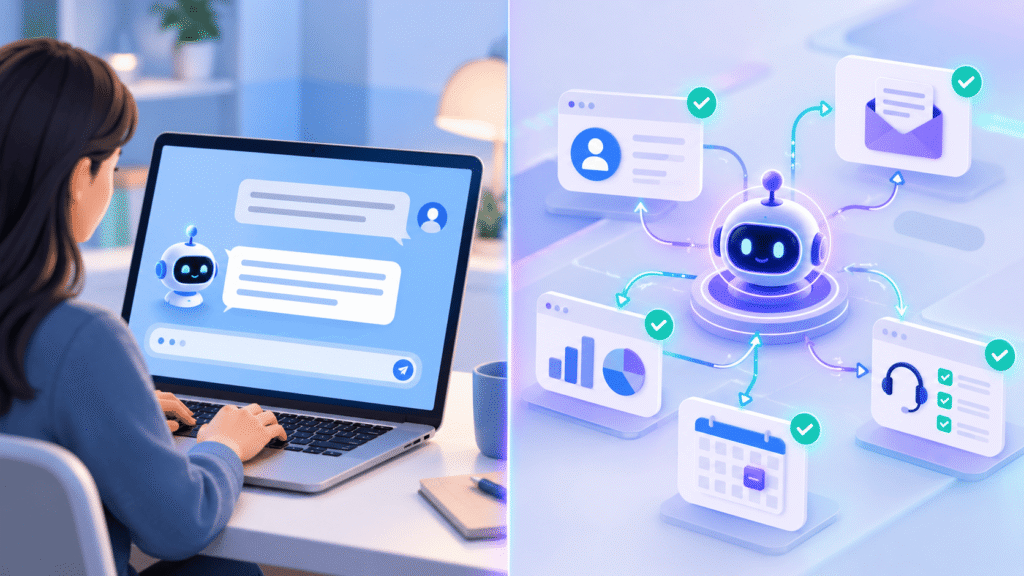
An AI assistant does the work for you. You set limits . An AI agent does a defined part of the job for you .
Both often use the same language models. The difference is the thing around the model: what it can see, how much it decides on its own, who checks its work. With vendors slapping the label “agentic” on just about anything, the question of AI agents versus AI assistants needs a clear, hype-free answer.
How AI assistants function
An assistant is helpful. You ask it a question and it gives you an answer. What you do next is up to you.
Older assistants were rule-based chatbots running on scripts. Today’s LLM-based assistants can write, summarize, analyze files and search the web. But they still halt after every response. If the marketer asks for five subject lines, he still choses one and sends the campaign.
How AI agents work
An agent is given a goal, not just a prompt. Then it runs a loop:
- Steps in planning
- Calls to tools and APIs (CRM, helpdesk, analytics, email, etc.)
- Verifies the result.
- Decides on next step, retries, or escalates to human
Agents usually are event driven (e.g. a new lead, a new ticket) and can run without being watched.
Key differences
Factor | AI assistant | AI agent |
|---|---|---|
Autonomy | Responds, then stops | Works toward a goal across steps |
Tool usage | Mostly read-only (search, files) | Reads and writes via APIs |
Memory | Current chat, light preferences | Task state and business history |
Planning | Human plans the steps | Breaks goals into steps itself |
Decision-making | Within one reply | Across the whole workflow |
Human oversight | Reviews every output | Sets rules, approves risky actions, audits logs |
Typical use cases | Drafting, research, brainstorming | Ticket triage, lead routing, CRM updates, reporting |
Real business examples
- Customer support: the assistant prepares a reply for the rep; the agent locates the order, resolves simple questions and escalates refunds.
- Lead Qualification: Assistant offers opinion on one lead. Agent scores each new lead, updates CRM and assigns a rep.
- Marketing automation: assistant writes ad copy, agent flags weak ads, queues new versions for approval.
- Reporting: an assistant summarizes the files you upload; an agent automatically builds the weekly report from the connected data.
- Research: An assistant answers a single question; an agent reads multiple sources and compiles a report with citations.
We at Digitech Markit usually suggest beginning with assistants and transforming one well-documented workflow into an agent.
When to use which
Use an assistant for creative work, strategy or one-off tasks, or where processes and data are not yet organized.
An agent is suitable for repetitive, rule-based tasks with several tools, where mistakes are easy to identify and fix.
Risks, limits and costs
Mistakes: Assistants might tell you wrong facts, agents might take wrong actions, sometimes at scale.
- Security: hidden instructions (prompt injection) can fool agents that read emails or web pages.
- Privacy: movement of customer data needs to comply with laws like the DPDP Act (India), the GDPR.
- Cost: Assistants are typically a monthly fixed seat, agents add model usage, integrations and monitoring time.
Lock down permissions, require human approval for any money or customer-facing actions, and log everything.
Today vs emerging
Now working on: support triage, lead routing, scheduled reporting, research and coding agents under human review. Still maturing: fully autonomous multi agent systems, agents running for long periods of time and agents that operate apps through the screen.
Conclusion
The key difference between AI agents and AI assistants is who takes the next action. Start with assistants. Add agents where processes are clear. Keep people in charge of decisions that matter. Follow Digitech Markit for more useful guides on AI and marketing.
Frequently Asked Questions
Can ChatGPT be considered an assistant or an agent?
Mostly assistant in chat, but now has agent-like features such as deep research and browsing.
Can an agent be an assistant?
Yes, when it gets tools, memory, a goal and permission to act across steps.
The safety of AI Agents for small businesses?
Yes, if you begin with one low risk workflow and minimal permissions.
Are agents here to replace marketing teams?
Not on the weight of evidence. They do the repetitive stuff; strategy and judgment are human.
Do AI agents need human supervision?
Yes. They are dependable with approvals, logs and escalation rules.